Intarsia vs. Jacquard: How the Two Knitting Techniques Differ
Intarsia knits colour blocks as a single layer: no floats inside, clean and flat, ideal for large logos and asymmetric graphics, but it needs hand-knotting so labour cost is higher. Jacquard carries yarns across the back, either as floats (single) or a two-layer mesh (double), making it denser and better for all-over patterns. Choose intarsia for lightness, jacquard for warmth and speed.
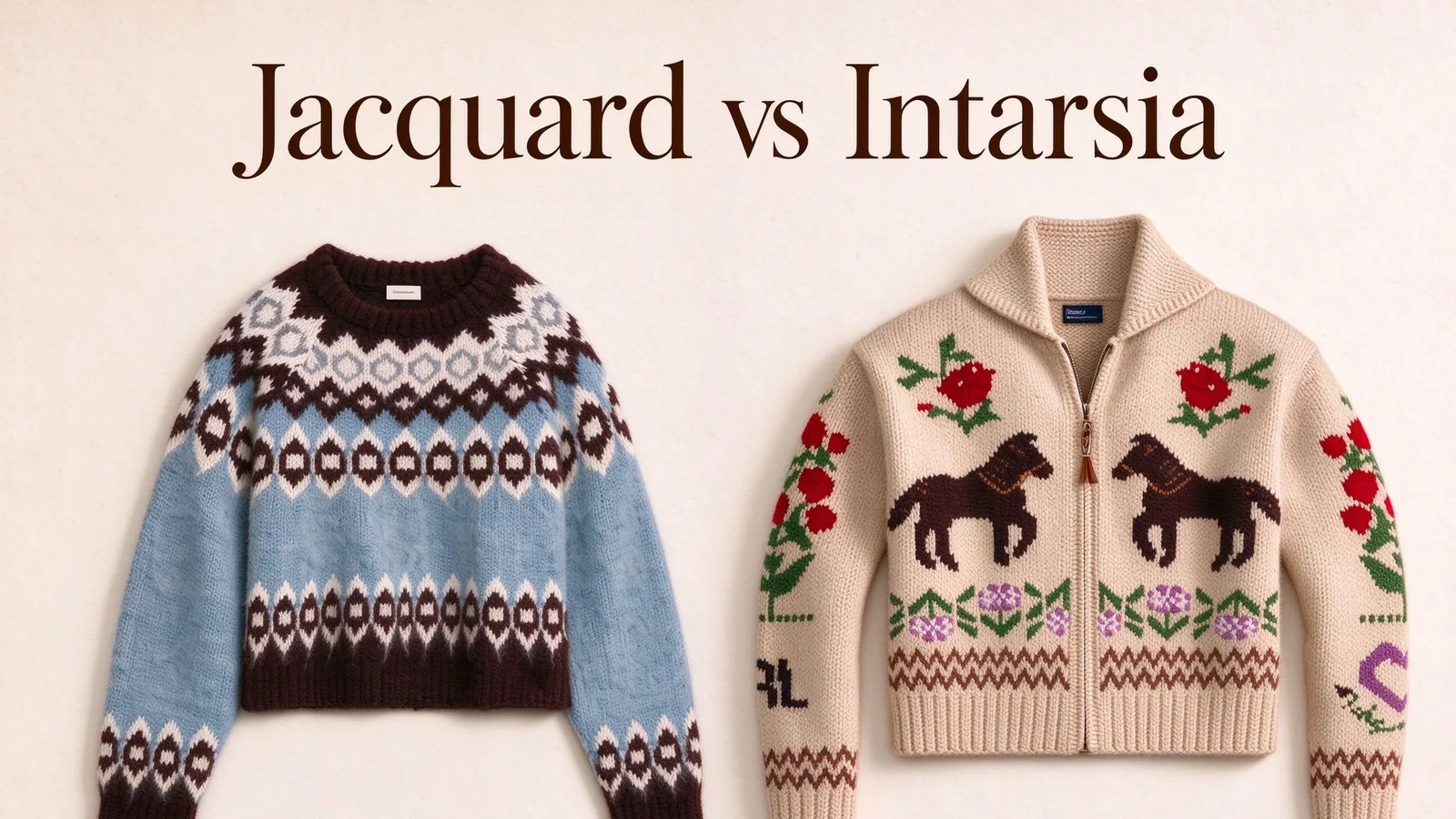
One is a single-layer colour puzzle, the other a layered multi-yarn build. How to choose between intarsia and jacquard for cost, comfort and design.
When an autumn/winter knit design includes multiple colours, large motifs, geometric colour-blocking or a brand logo, designers and buyers face a key question: intarsia or jacquard?
Both can render rich pattern and colour on the surface, but they differ fundamentally in knitting principle, reverse-side construction, comfort, cost and MOQ.
This guide breaks down the technical difference so you can balance design impact against production budget.
1. Core concepts and knitting principles
The quickest way to understand the two techniques is to look at the inside of the sweater.
Intarsia — clean colour blocks on the face, no floats inside, flat and tidy, hand-knotted yarn ends.
Jacquard — rich pattern on the face, floats or a double-layer structure inside, highly automated.
1) Intarsia: a single-layer colour puzzle
Intarsia works like a jigsaw in yarn. When the machine reaches a colour block it switches to that yarn; when it leaves the block, the yarn is cut or changed.
- Inside: no floats at all. Both faces are single-layer fabric, with even thickness throughout.
- Handwork: on complex multi-colour intarsia, every yarn tail left at a colour boundary must be hand-knotted and tucked into the back — preventing unraveling and keeping the inside flat.
2) Jacquard: multiple yarns carried and layered
Jacquard knits several coloured yarns at once. When a colour is not needed on the face, it is carried across the back.
- Single jacquard: the back carries floats of varying length, which fingers or jewellery can catch when dressing.
- Double / full jacquard: the back is knitted as a mesh, honeycomb or reverse motif, enclosing all floats in a two-layer structure. The garment becomes noticeably thicker and heavier.
2. Intarsia vs. jacquard across five dimensions
| Dimension | Intarsia | Jacquard |
|---|---|---|
| Inside appearance | Extremely clean and flat, no floats, comfortable against skin | Floats (single) or a two-layer mesh (double) |
| Thickness & weight | Light, single-layer, breathable | Heavier and thicker, especially double jacquard |
| Design limits | Best for large colour blocks, big motifs, asymmetric colour-blocking | Best for small vintage motifs, all-over repeats, houndstooth |
| Labour & cost | High labour cost — hand-knotting and tucking tails | Highly automated, shorter labour time |
| Yarn consumption | Lower — yarn is used only where the motif sits | Higher — carried yarn adds weight |
3. Choosing the right technique
When to choose intarsia
- Large logos and motifs: an oversized bear on one chest panel, big brand lettering, bold geometric colour-blocking.
- Lightness and comfort: 12G base layers, close-fitting cashmere, spring/summer fine cardigans — no floats means a bare-skin feel.
- Premium and minimalist positioning: intarsia signals hand-craft labour and lifts perceived value.
When to choose jacquard
- All-over and vintage patterns: Fair Isle snowflakes, houndstooth, repeating logos.
- Warm heavyweight styles: double jacquard creates a two-layer air pocket — ideal for 3G/5G/7G outerwear.
- Value and speed: most of the work is automated and there is no heavy hand-knotting, so bulk delivery is faster.
4. Sourcing and cost-control advice
- Price the handwork: intarsia programming is complex (yarn paths must be planned) and hand-knotting is time-consuming. On 50–100 piece runs of multi-colour intarsia, the per-piece labour is higher than jacquard.
- Tack long floats: on single jacquard, any float longer than 1.5 cm should be tucked/tacked to the reverse so it cannot snag.
- Use stock yarn to lower MOQ: multi-colour designs need many shades. Choosing the factory's stock yarn lets you start at 50 pieces even when each colour quantity is small.
In summary
Large motifs, single-layer lightness, next-to-skin comfort and a hand-crafted feel → intarsia. All-over patterns, heavyweight warmth, efficiency and automation → jacquard.
Match the technique to your market position, season and budget, and you get a knit that is both striking and commercially competitive.
About Jinya Knitwear
Looking for a source factory that can execute both intarsia and jacquard precisely? Jinya handles the whole path from yarn routing to bulk delivery.
- Craft depth: Intarsia and jacquard both handled in-house, with 15+ years of technical experience behind programming and production set-up.
- Clean reverse side: Every intarsia tail is hand-knotted and tucked, so both faces of the garment look finished and flat.
- Full gauge & category range: 1.5GG–16GG computerized flat machines; menswear, womenswear, kidswear plus beanies, scarves and gloves.
- Low MOQ: From 50 pieces, using the market's stock yarn to help new brands test the waters fast.
- Fast sampling & refund: 3–7 day sampling; 100% of the sampling fee refunded on orders of 300+ pieces of the same style.
Which is more expensive, intarsia or jacquard?
Intarsia, because every colour boundary is hand-knotted and tucked. The gap is largest on small orders.
Which has the cleaner reverse side?
Intarsia — no floats at all. Single jacquard carries floats; double jacquard hides them inside a two-layer mesh.
Which should I choose for a large logo?
Intarsia: it keeps a single-layer, flat and comfortable panel for large or asymmetric graphics.
Which is better for all-over patterns?
Jacquard: it handles repeats, Fair Isle and houndstooth efficiently and adds warmth in double-layer form.
Olivia handles operations content for Jinya, covering knitwear sourcing, product development and garment care — turning the questions buyers ask on the factory floor into practical, checkable guides.
Ms. Liu has run knitting floors for more than 20 years, overseeing yarn routing, machine programming, linking and final QC. She reviews every technical claim published here.