What a 50-Piece Sweater Run Actually Costs
At 50 pieces, fixed costs — programming, machine setup, trims, sampling — are spread over far fewer garments, so the same 12GG merino crewneck can cost roughly 40–60% more per piece than at 300. Yarn and labour barely change; setup and label minimums do. Use stock yarn colours, limit colourways and plan a repeat to bring the unit price down.
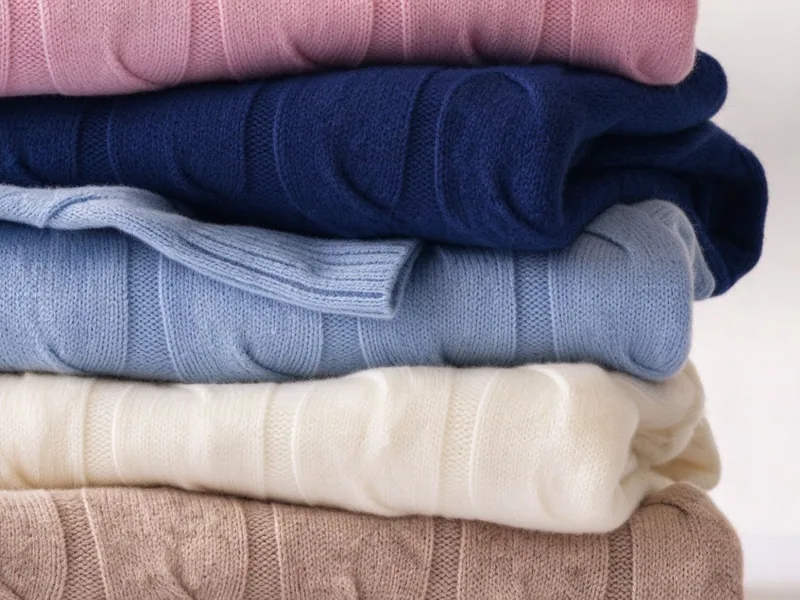
Why one sweater costs more at 50 pieces than at 300 — yarn minimums, machine setup, trims and sampling — plus the costs you can actually control.
Every small brand asks the same question at the first quote: why does one sweater cost more when I order 50 than when I order 300? The answer is not that the factory is punishing small orders. It is arithmetic — a set of fixed costs is being divided by a much smaller number.
This article breaks the cost into its parts, shows an indicative range for a 12GG merino crewneck, and explains which levers are actually in your hands.
The five costs that do not shrink with the order
Some costs scale with quantity: yarn, knitting time, linking, packing. Others are fixed per style or per colour, and they behave very differently at 50 pieces.
- Programming and machine setup — the loom must be programmed, calibrated and test-knitted once per style, whether you make 50 or 500.
- Yarn minimums — stock colours have no minimum, but a custom dye lot often starts at 100+ kg.
- Trims — woven labels, care labels and bags are ordered by the thousand.
- Sampling — the sample is a one-off cost that must be absorbed somewhere.
- QC and packing — mostly per piece, with a fixed admin layer per shipment.
An indicative breakdown: 12GG merino crewneck
The table below is an illustrative range in USD, ex-works, for a 380–450g 12GG merino-blend crewneck in one colourway. It is not a quote — yarn price, gauge, stitch complexity and finishing all move the numbers.
| Cost item | 50 pcs | 300 pcs |
|---|---|---|
| Yarn (380–450g) | $11–17 | $10–15 |
| Knitting + linking labour | $8–12 | $6–9 |
| Trims & labels | $2–4 | $1.5–3 |
| Setup & sampling allocation | $6–10 | $1–2 |
| QC & packing | $1.5–2.5 | $1.5–2.5 |
| Indicative ex-works unit cost | $45–65 | $30–45 |
Where the 40–60% difference comes from
Yarn and labour together change by only a few dollars. The real gap sits in setup and sampling allocation: at 50 pieces, $400 of programming and sample work adds $8 per garment; at 300 pieces it adds about $1.30.
Label minimums work the same way. A 1,000-piece label run costs the same whether you use 50 or 300, but the unused labels sit in a warehouse until your repeat order.
What you can actually control
You cannot remove machine setup, but you can spread it better. These four decisions move the unit price more than negotiating the labour rate.
- Use stock yarn colours — no dye-lot minimum, no 3–4 week dyeing lead time.
- Keep the first order to one or two colourways; add colours on the repeat.
- Share one label and one care label across styles to use the minimum faster.
- Plan the repeat before you order — setup and labels are already paid for.
When 50 pieces is the right call
If you need to test a silhouette, validate a price point or photograph a collection before committing capital, 50 pieces is cheaper than being wrong with 300. The higher unit cost is the price of information.
The rule of thumb: place 50 when demand is unproven, 300 when you have a waitlist or a repeat buyer. Our low-MOQ manufacturing page explains how the two quantities are quoted side by side.
Why is the unit price at 50 pieces higher than at 300?
Fixed costs — programming, machine setup, trims, sampling — are spread over fewer garments. Yarn and labour change only slightly; setup allocation is the main difference.
Can I get a lower price by ordering 50 pieces in five colours?
Usually not. Each colour adds setup and a possible dye minimum. Fewer colours at 50 pieces is almost always cheaper per unit than five colours at 10 pieces each.
Does the sample fee disappear at 50 pieces?
Not at 50. The sample fee is refunded in full once a bulk order of 300+ pieces per style is placed; below that it is charged.
What is the cheapest way to test a knitwear design?
One style, one stock yarn colour, 50 pieces, shared labels, and a plan to reorder if it sells. That keeps setup and minimums to a single cycle.
Olivia handles operations content for Jinya, covering knitwear sourcing, product development and garment care — turning the questions buyers ask on the factory floor into practical, checkable guides.
Ms. Liu has run knitting floors for more than 20 years, overseeing yarn routing, machine programming, linking and final QC. She reviews every technical claim published here.